From the Series: Daily Welfare — Meeting Needs Properly
Introduction
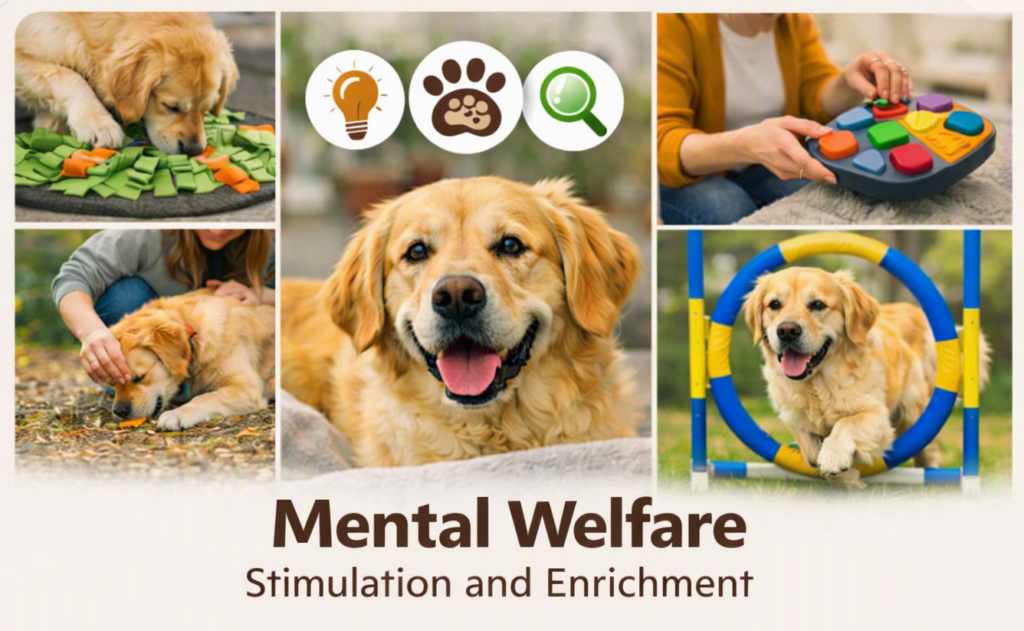
Mental welfare keeps a dog’s mind engaged, confident, and emotionally stable. Dogs are natural problem‑solvers and explorers; when their mental needs are unmet, frustration, boredom, and behavioural issues follow. This part explains how to meet mental needs through stimulation, enrichment, and thoughtful daily routines.
1. Understanding Mental Welfare
What Mental Stimulation Really Means
Mental stimulation is not about tiring a dog out — it’s about engaging the brain.
Dogs need opportunities to think, explore, solve problems, and use their senses.
Core Components
- Cognitive Challenges — Problem‑solving tasks, puzzles, learning new skills.
- Sensory Enrichment — Smells, textures, sounds, safe exploration.
- Environmental Variety — New walking routes, novel objects, controlled novelty.
- Learning & Training — Short, positive sessions that build confidence.
2. Types of Enrichment
Scent‑Based Enrichment
Dogs experience the world primarily through smell.
Examples include:
- Scatter feeding
- Snuffle mats
- Hide‑and‑seek treats
- Scent trails
Cognitive Enrichment
Activities that make dogs think.
- Puzzle feeders
- Problem‑solving games
- Training new cues
- Object discrimination games
Physical–Mental Combination Enrichment
Movement paired with thinking.
- Slow sniff‑walks
- Obstacle navigation
- Controlled exploration
- Low‑impact agility for confidence
3. Preventing Boredom and Frustration
Recognising Mental Underload
Signs include:
- Destructive chewing
- Excessive barking
- Restlessness
- Repetitive behaviours
- Withdrawal or low mood
Balancing Stimulation
Mental welfare is about quality, not constant activity.
Over‑stimulation can be just as harmful as under‑stimulation.
4. Daily Mental Welfare Practices
Simple Daily Additions
- Morning: 5‑minute scent game
- Midday: Puzzle feeder or training session
- Evening: Calm enrichment (lick mat, gentle exploration)
- Walks: Allow sniffing, choice, and slow exploration
Rotating Enrichment
Dogs thrive on novelty — but controlled novelty.
Rotate toys, puzzles, and activities to keep things fresh without overwhelming the dog.
5. Mental Welfare in Busy Homes
Low‑Effort, High‑Impact Options
- Scatter feeding instead of bowl feeding
- Sniff‑walks instead of fast walks
- Short training sessions (2–3 minutes)
- Frozen enrichment for quiet time
- Simple household objects repurposed safely for puzzles
These require minimal time but deliver major welfare benefits.
Closing
Mental welfare is the pillar that transforms behaviour, confidence, and emotional stability.
When owners meet mental needs consistently, dogs become calmer, happier, and far more resilient.
Next, we move into Part 4 — Emotional Welfare: Security and Trust, where we explore how predictability and gentle handling shape a dog’s inner world. As with every blog post, this will be made available next week Monday, August 10th, 2026.