From the Series: Understanding Dog Punishment in China — A Behaviourist’s Guide
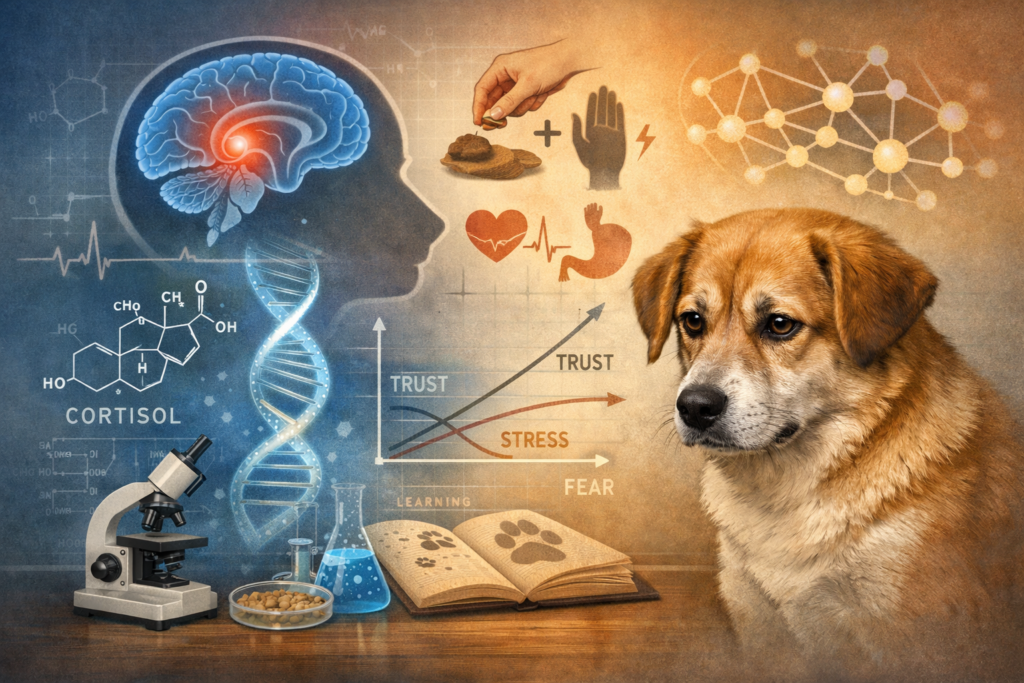
Punishment doesn’t just change behaviour — it changes the brain. Every slap, shout, or fearful moment alters how a dog processes information, forms associations, and responds to humans. Understanding this science reveals why punishment fails and how trust heals.
1. The Stress Response: Cortisol and Fear
When a dog is punished, its body releases cortisol — the stress hormone. Cortisol prepares the body for survival, not learning.
What happens biologically:
- Heart rate increases
- Muscles tense
- Digestion slows
- Memory formation shuts down
Learning requires calm focus.
Punishment replaces calm with panic.
2. The Amygdala Hijack
The amygdala controls fear and emotional memory. When activated by punishment, it overrides the prefrontal cortex — the part responsible for decision‑making and learning.
Result: The dog stops thinking and starts reacting.
It learns to avoid pain, not to understand behaviour.
This is why dogs “comply” but don’t truly learn.
3. The Breakdown of Association
Dogs learn through classical and operant conditioning — forming links between actions and outcomes.
Punishment confuses those links:
- The dog can’t connect the punishment to the behaviour.
- The timing is almost always wrong.
- The dog associates fear with the human, not the action.
Instead of learning “don’t chew shoes,” the dog learns “humans are unpredictable.”
4. The Collapse of Trust
Trust is the foundation of all cooperative behaviour. When punishment replaces guidance, the dog’s emotional safety collapses.
Signs of trust breakdown:
- Avoidance of eye contact
- Fear of touch
- Hiding or freezing
- Defensive aggression
Once trust is broken, learning slows dramatically — because the dog no longer feels safe enough to experiment or make mistakes.
5. The Cycle of Fear and Compliance
Punishment creates a cycle:
- Dog misbehaves → owner punishes
- Dog fears owner → avoids behaviour
- Owner sees “obedience” → repeats punishment
- Dog’s fear deepens → behaviour returns under stress
This cycle looks like success but is actually suppression. Suppressed behaviour resurfaces later — often stronger, more unpredictable, and more dangerous.
6. The Long‑Term Effects
Chronic punishment leads to:
- Elevated cortisol levels
- Weakened immune system
- Digestive issues
- Learned helplessness
- Depression‑like symptoms
Dogs stop trying to learn because they believe nothing they do will change the outcome.
That’s not obedience — that’s despair.
7. The Science of Healing
The opposite of punishment is positive reinforcement — rewarding desired behaviour. It activates dopamine, the brain’s “feel‑good” chemical, which strengthens learning and trust.
When dogs feel safe:
- They explore
- They learn faster
- They bond deeply
- They repeat good behaviour willingly
Safety isn’t a luxury — it’s the foundation of learning.
Closing Thoughts for Part 3
Punishment doesn’t teach.
It rewires the brain for fear, not understanding.
It replaces curiosity with caution, and trust with survival.
Behavioural science proves what compassion already knows:
Dogs learn best when they feel safe.
In Part 4: Building Trust Through Positive Reinforcement, we’ll explore how to rebuild that safety — step by step, through kindness and consistency.
Related posts:

Part 3: Dog Categories and Their Implications
“Help! My Puppy/Dog Is Urinating All Over My Apartment!” — A Clear, Calm Guide for Chinese Dog Owner...

Part 4 — Puppy vs Adult Dog

Series Introduction: Choosing Your Dog Wisely.